|
|
At the core of this process is the RTech Ray 2 scanner, a lidar-based device capable of capturing entire buildings and factory floors. This scanner spins 360 degrees, emitting a blade of laser light to create a detailed “point cloud.” A point cloud is a massive set of data points that forms a three-dimensional representation of the scanned space.
Once captured, this point cloud data is imported into software like Artex Studio. This step allows users to visualize the scanned environment in high detail. They can navigate the virtual space, inspect specific areas and get a complete understanding of the existing layout without being physically present. This digital twin offers an accurate foundation for all subsequent design work.
The session showed how to take this point cloud data and use it with the Virtual Factory Simulation Professional role on the 3DEXPERIENCE platform for plant layout design. This powerful solution, part of the SOLIDWORKS Manufacturing portfolio, allows engineers to import the scanned data and overlay it with CAD models of new equipment, tooling, or production lines.
A key feature discussed was the use of parameterized catalog items. These are pre-designed 3D models of common factory components. Because they are parameterized, designers can easily adjust their dimensions to fit specific requirements. This ability to quickly place and modify equipment within the accurate 3D scan saves significant time and reduces the risk of placement errors.
The benefits of using 3D scanning for factory design are clear. The technology drastically cuts down the time required for reverse engineering and layout modifications. What once took days or weeks of manual measurement can now be accomplished in hours. This speed allows companies to react more quickly to production changes and implement improvements faster.
By starting with a precise digital model of the current state, project teams can identify potential clashes and design challenges early in the process. This foresight prevents costly rework during installation and ensures a smoother project execution from start to finish.
Numerous manufacturers have successfully implemented virtual factory simulation software to improve their operations, including many SMBs. One such company is Behlen Manufacturing Co., a 100-year-old metal manufacturer with over 1,100 employees, located in Columbus, Nebraska. Due to over 80 years of operations at the massive factory, the multiple business units have overlapping production lines and processes, resulting in a stockpile of old, new, and custom-made equipment—some still used and some not; various materials; and a variety of furniture, cabinetry, and storage racks. Over the years, each business unit has taken up any available space, contributing to bottlenecks that impede factory flow.
“Our plant layout has become something of a hodgepodge with certain jobs moving back and forth from one end of the building to the other when they could have benefited from better flow within the factory plant layout,” explains Process Engineer James Kucera.
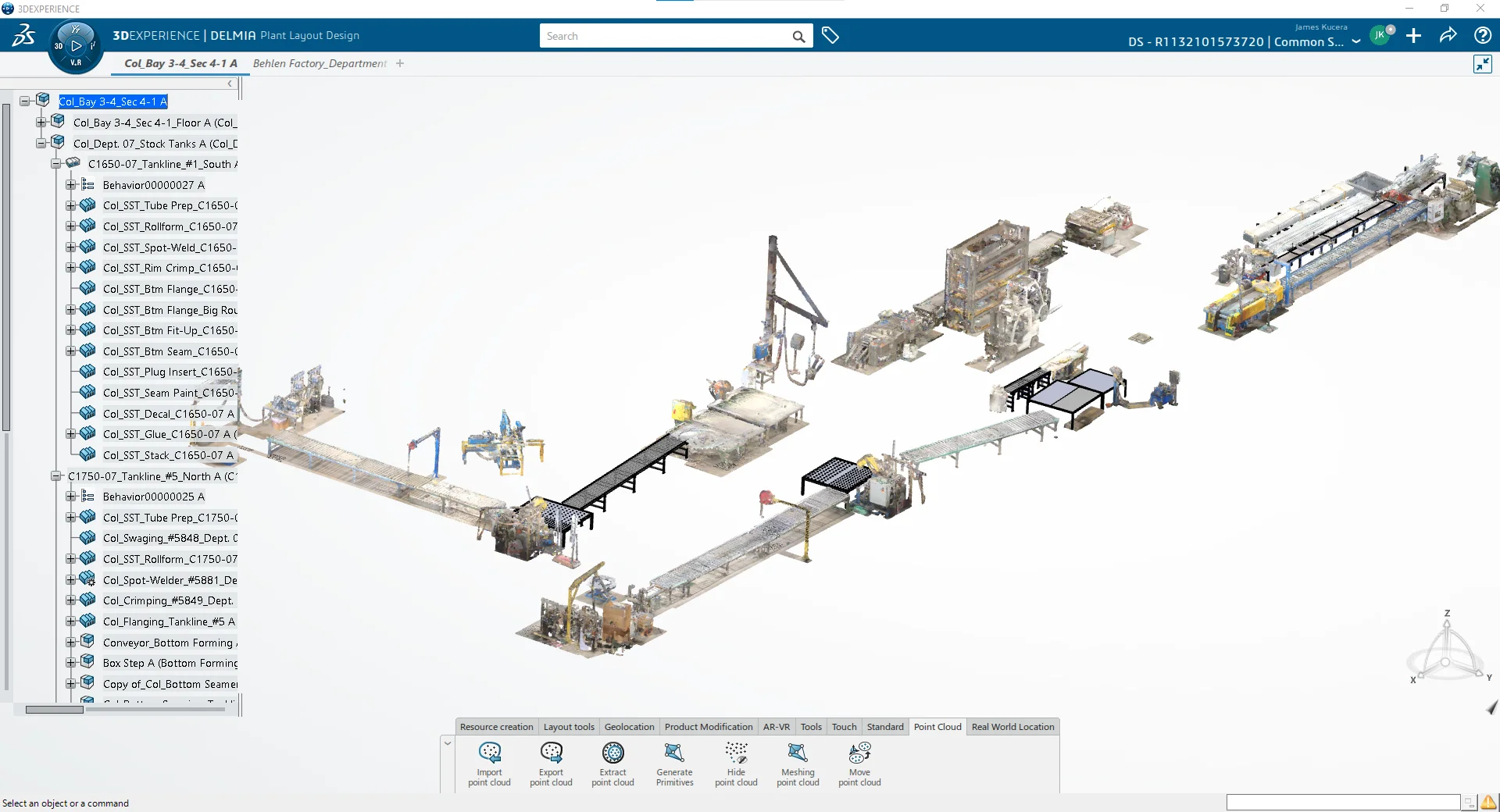
After an intensive search, Behlen invested in the cloud-based Factory Simulation Engineer, one of the SOLIDWORKS Manufacturing solutions. Factory simulation enables Behlen to analyze multiple production scenarios in 2D, 3D, or point-cloud environments, and delivers a 3D visualization of the facility to diagnose problem areas and improve performance.
Behlen scanned its entire 900,000-square-foot factory in a week, producing over 3 billion cloud data points from which a virtual 3D model was created. The data is broken down into six-by-eight-foot grid sections that model everything in the plant, from conveyors to trash cans. Factory Simulation Engineer provides data granularity down to 1/16 inch for every item, so it’s easy to visualize the exact impact of potential configuration changes.
Behlen has laid the foundation for coordinating many lean manufacturing approaches of smart factories with the help of the Factory Simulation Engineer role. The company will use the solution to evaluate material, process, and other workflows to improve standardization, efficiency, and collaboration of business and engineering groups across the factory.
|
|
 |小黑屋|手机版|Archiver|机械荟萃山庄
( 辽ICP备16011317号-1 )
|小黑屋|手机版|Archiver|机械荟萃山庄
( 辽ICP备16011317号-1 )


 发表于 2026-6-1 10:52:02