|
|
At SOLIDWORKS, we believe simulation should be an integral part of the design process, not an afterthought handed off to a dedicated team after the design is already mature. When engineers can validate their own work early, they catch issues before they become expensive, build deeper intuition about how their products behave under load, and bring better products to market faster.
Your customers’ expectations are rising, and engineering companies face increasing pressure to deliver innovative solutions that meet strict performance targets while compressing development timelines. Finite element analysis (FEA) and computational fluid dynamics (CFD) are two of the most effective tools available for meeting that challenge. They allow teams to predict real-world product performance virtually before a prototype is built.
The new simulation roles in the SOLIDWORKS portfolio are designed to help meet this demand by providing scalable simulation capabilities tailored to different levels of engineering analysis. Whether users need quick design validation, advanced structural analysis, or detailed CFD studies, these roles provide a connected MODSIM workflow that integrates design and simulation on the 3DEXPERIENCE platform.
By combining cloud-connected collaboration, high-performance computing, secure data management, and integrated learning resources, these roles help organizations expand simulation adoption across teams while enabling engineers to make faster, more informed design decisions with confidence.
expanding to the cloud-based simulation capabilities on the 3DEXPERIENCE platform. These roles support the full design journey, from structural validation to advanced fatigue and fluid flow analysis of your CAD models and assemblies. The three structural (FEA) simulation roles, namely SOLIDWORKS Simulation Designer, SOLIDWORKS Simulation Engineer, and SOLIDWORKS Simulation Analyst were introduced with R2026x FD01, followed by SOLIDWORKS Simulation CFD Engineer in R2026x FD02.
Now your designs are backed by cloud-based simulation capabilities, bringing structural and CFD analysis together in a connected MODSIM workflow that helps you innovate with confidence from concept to validation.
All four roles are cloud-connected, giving every user access to cloud computing, secure data management, real-time collaboration, and self-paced learning through the SOLIDWORKS Learner on the 3DEXPERIENCE platform.
SOLIDWORKS Simulation Designer
From CAD to Confidence: Fast, Accurate Structural Simulation for Design Engineers
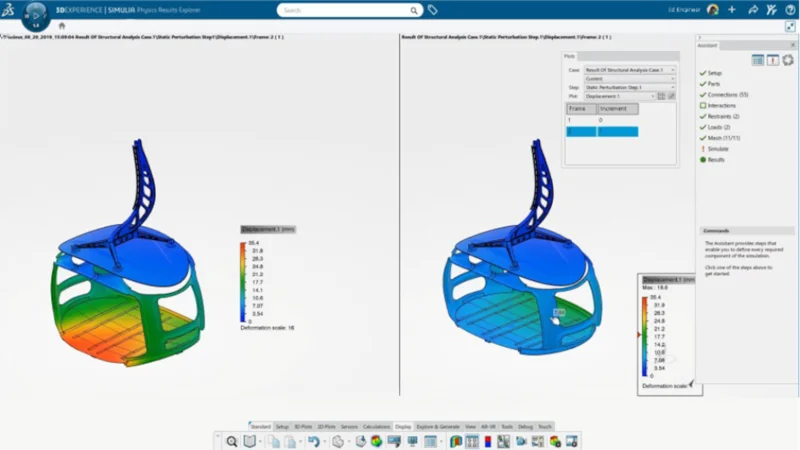
SOLIDWORKS Simulation Designer gives design engineers robust linear structural analysis capabilities to evaluate product performance throughout development. It equips design teams with all the tools needed to efficiently run linear static, frequency, buckling, steady-state thermal, and modal dynamic response studies.
SOLIDWORKS Simulation Designer bundles the capabilities of Structural Engineer, Simulation Collaboration, SOLIDWORKS Learner, and Platform Extended Storage into a single, cloud-connected role.
Key capabilities include:
Run what-if scenarios with geometry-linked updates to quickly refine designs and hit performance targets.
Assess product behavior under structural loads using a comprehensive set of load and boundary condition types. Set up robust contact quickly in large assemblies with the General Contact capability.
Create high-quality solid meshes directly on your design geometry with rule-based controls for accurate results, powered by proven Abaqus solver technology.
SOLIDWORKS Simulation Engineer
Beyond the Basics: Advanced linear and nonlinear structural analysis for Product Engineers
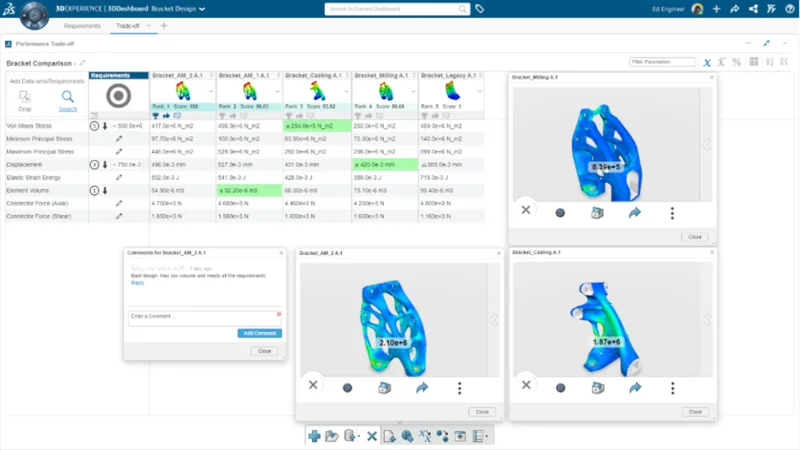
Building on the capabilities of SOLIDWORKS Simulation Designer, SOLIDWORKS Simulation Engineer is a powerful, intuitive structural analysis solution designed to assess and optimize product performance and quality under sophisticated structural loads during the design process. It is the right choice for design engineers who need to go beyond linear analysis to address problems involving large deformations, nonlinear material behavior, or complex multi-step loading conditions.
SOLIDWORKS Simulation Engineer enables design engineers to solve complex linear and nonlinear structural analyses, including static, frequency, buckling, thermal, and modal dynamic studies with multi-step scenarios. Cloud computing on the 3DEXPERIENCE platform accelerates solve times, while a unified environment enables you to visualize results, collaborate with your team, and manage simulation data securely alongside your design geometry.
SOLIDWORKS Simulation Engineer bundles the capabilities of Structural Performance Engineer, Simulation Collaboration, SOLIDWORKS Learner, and Platform Extended Storage into a single role.
Specifically, with SOLIDWORKS Simulation Engineer, you can:
Run advanced structural simulations throughout the design process with a streamlined engineering workflow with powerful, intuitive tools and access to industry-leading Abaqus simulation technology throughout the design process.
Evaluate “what-if” scenarios quickly through seamless associativity with design geometry.
Simulate multi-step structural scenarios to realistically assess product performance and quality.
Solve on local or cloud compute with embedded computing up to eight cores, reducing hardware limitations.
Accelerate simulation setup and turnaround with automated mesh creation for large assemblies.
Visualize high-performance simulation results efficiently, even for very large models.
SOLIDWORKS Simulation Analyst
Predict Fatigue Failure Before It Happens: Advanced Durability and Dynamics Analysis
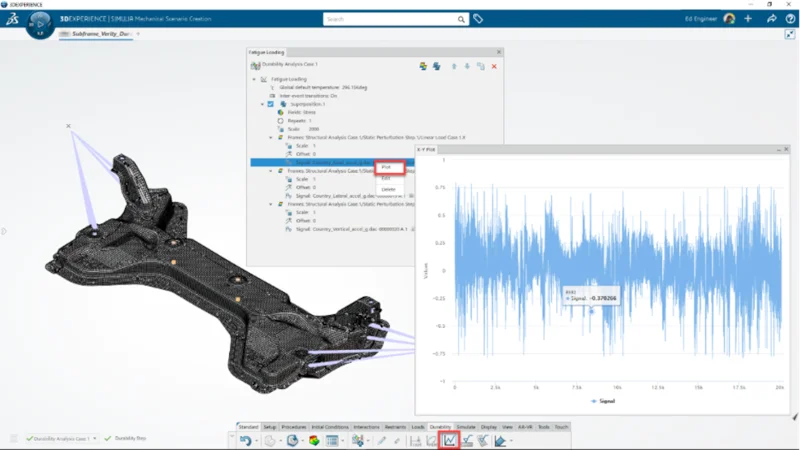
SOLIDWORKS Simulation Analyst gives engineers and analysts advanced structural validation capabilities to assess performance and safety under the most extreme conditions. This role delivers industry-leading structural and fatigue simulation to validate product durability, integrity, and lifecycle performance under real-world conditions.
Building on linear and nonlinear analysis, SOLIDWORKS Simulation Analyst enables engineers to perform physically realistic static, dynamic, and fatigue studies, including implicit and explicit dynamics, reducing dependence on physical testing and increasing confidence in product reliability. Advanced modeling, meshing, and contact capabilities support complex operating scenarios, while parametric multi-objective design studies help engineers balance competing performance goals.
SOLIDWORKS Simulation Analyst bundles the capabilities of Durability and Mechanics Engineer, Simulation Collaboration, SOLIDWORKS Learner, and Platform Extended Storage into a single role.
Specifically, SOLIDWORKS Simulation Analyst allows you to:
Assess structural performance using multistep scenarios powered by Abaqus, including static, frequency, thermal, buckling, and implicit/explicit dynamic analyses
Predict accurate fatigue life for both high-cycle and low-cycle loading scenarios, ensuring durable designs for extending service life and reducing late redesigns, physical testing, and warranty costs.
Estimate component lifecycle under cyclic loading using stress- and strain-based durability methods during the design phase
Predict fatigue life for both high-cycle and low-cycle loading scenarios.
Simulate drop-test and crash scenarios using a proven explicit solver.
Use and calibrate a wide range of material models with built-in material calibration capabilities.
Accelerate design innovation by solving engineering challenges directly on 3D designs with full geometry associativity.
Perform strength and durability assessments using guided, customizable workflows for fast adoption and reduced learning curve.
With scalable data management, collaborative workflows, and powerful visualization backed by platform storage, SOLIDWORKS Simulation Analyst empowers teams to predict failure, optimize durability, and make data-driven design decisions faster.
SOLIDWORKS Simulation CFD Engineer
Design for Flow: Fluid and Thermal Simulation Without the CFD Specialist
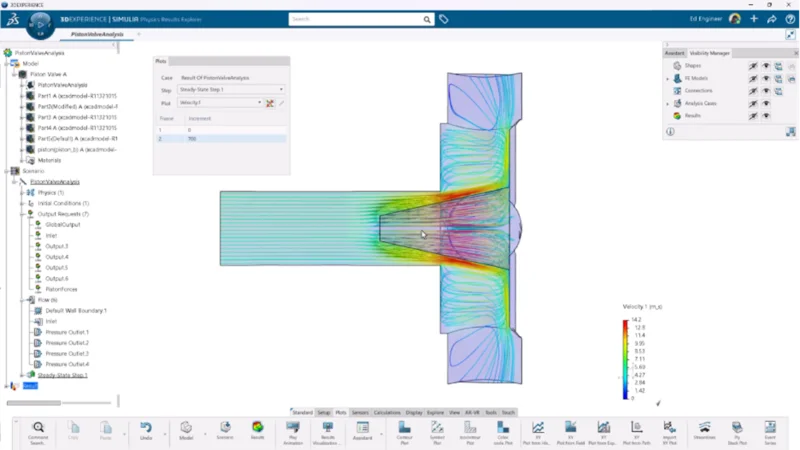
Introduced with R2026x FD02, SOLIDWORKS Simulation CFD Engineer brings advanced CFD capabilities to the same cloud-connected platform experience as the structural roles. This role offers advanced flow simulation technology, collaboration tools, platform storage, and access to training materials, thereby enabling design teams to predict real-world fluid flow and thermal performance before building physical prototypes.
A guided assistant panel, automatic fluid domain creation directly from SOLIDWORKS models, and an easy-to-use Physics Manager make simulation setup fast and accessible even for design engineers without dedicated CFD expertise. Robust automatic meshing and cloud computing accelerate solution time, while built-in design-scenario comparison makes it straightforward to evaluate alternatives and identify the best-performing configuration.
SOLIDWORKS Simulation CFD Engineer includes apps for advanced fluid flow simulation, the Platform Extended Storage app, and SOLIDWORKS Learner.
SOLIDWORKS Simulation CFD Engineer enables your team to:
Work within a unified CAD-CFD environment for concurrent simulation and design, covering pre-processing, solving, and post-processing in one place.
Navigate the full CFD workflow from model setup to results post-processing with a built-in user assistant that guides each step and simplifies common fluid analyses.
Solve steady-state and long-transient fluid flow and heat transfer problems using an industry-standard RANS-based finite volume solver with automatically selected turbulence models.
Converge simulations faster using patented error estimator technology that predicts convergence errors and eliminates wasted iterations.
Model complex multi-domain simulations with built-in Fluid-Structure Interaction (FSI) and native Conjugate Heat Transfer (CHT) capabilities.
Improve simulation efficiency, robustness, and accuracy by selecting pre-defined rules based on simulation type.
Prepare and clean up simulation geometry using built-in model prep tools without leaving the environment.
Validate KPIs and product requirements through simulation and explore performance trade-offs early in the design cycle.
Visualize high-performance results and generate reports automatically.
Identify and compare product design alternatives automatically using the Parametric Design Study capability.
Evaluate the impact of design changes and collaborate on results directly on the 3DEXPERIENCE platform.
Build CFD competency at your own pace with access to the SOLIDWORKS Learner app for self-paced training.
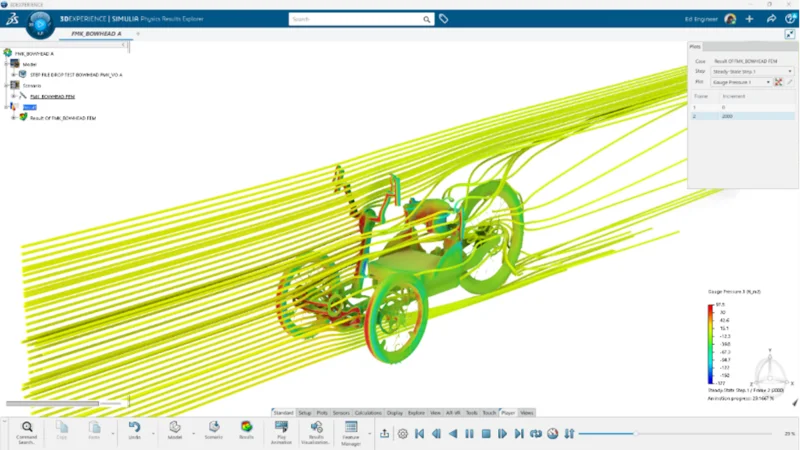
What makes these roles particularly powerful is that they form a coherent progression. A design engineer can begin with SOLIDWORKS Simulation Designer to run linear structural studies and grow into SOLIDWORKS Simulation Engineer as analysis requirements become more complex. Teams with advanced validation needs have SOLIDWORKS Simulation Analyst, while fluid and thermal specialists have SOLIDWORKS Simulation CFD Engineer, all within the same platform, with the same data model and collaboration infrastructure.
We believe it is critical for SOLIDWORKS users to run simulations themselves during the design process, rather than waiting to hand work off to a dedicated analyst late in development. Finding and resolving issues early avoids costly corrections, reduces the number of physical prototypes needed, and helps engineers build lasting intuition about how their designs perform under real-world loads, equipping them with the knowledge that makes every future design better.
|
|
 |小黑屋|手机版|Archiver|机械荟萃山庄
( 辽ICP备16011317号-1 )
|小黑屋|手机版|Archiver|机械荟萃山庄
( 辽ICP备16011317号-1 )


 发表于 2026-5-30 20:31:04